

Laser Safety
Laser Engraving Fumes: What You Can’t See Can Still Hurt You
Nov
Why smoke-free doesn’t always mean safe—and what every laser owner should know about air filtration and ventilation.
Laser engraving fumes can contain microscopic particles, chemical vapors, and potentially harmful gases—even when little or no visible smoke is present.
Whether you’re engraving tumblers, cutting acrylic, marking coated metals, or personalizing wooden products, understanding these emissions is an important part of operating a laser responsibly.
Whether you’re engraving tumblers, cutting acrylic, marking coated metals, or personalizing wooden products, laser engraving can produce more than beautiful results.
It can also release microscopic particles, chemical vapors, and potentially harmful gases into the surrounding air.
Some are visible as smoke. Others are completely invisible.
And just because the smoke disappears doesn’t mean the air is clean.
Understanding how laser fumes behave—and how to manage them—is an important part of operating a laser responsibly.
What’s Really in Laser Smoke?
When laser energy interacts with a material, it can heat, melt, vaporize, or chemically break down the surface.
The resulting airborne contaminants depend heavily on the material being processed.
| Material | Potential emissions |
|---|---|
| Wood and plywood | Fine particles, VOCs, formaldehyde |
| Acrylic | Organic vapors, including methyl methacrylate |
| Leather | Smoke and organic decomposition products |
| Painted or coated metals | Coating particles and chemical vapors |
| Plastics | Material-dependent gases and potentially hazardous compounds |
These emissions are often called laser-generated air contaminants (LGACs).
Even processes producing very little visible smoke can release gases or ultrafine particles.
That’s why relying on your eyes—or your sense of smell—isn’t enough to determine whether your workspace air is safe.
Why HEPA Filters Don’t Tell the Whole Story
Many laser air purifiers advertise impressive filtration ratings, sometimes claiming to capture 99.97% of airborne particles.
That sounds reassuring, but there’s an important distinction.
HEPA filters capture particles. They don’t remove gases simply by filtering the air.
A properly rated HEPA filter is extremely effective at capturing fine airborne particles, including much of the particulate matter found in laser smoke.
But chemical vapors and gases can pass through.
That means a purifier may remove visible smoke while allowing some potentially harmful gaseous contaminants to remain.
This is why many professional fume extraction systems use multiple filtration stages, including activated carbon.
Activated Carbon: Helpful, but Not Magic
Activated carbon is widely used to remove odors and certain chemical vapors.
Its porous structure allows gas molecules to attach to the carbon’s surface through a process called adsorption.
However, not all activated carbon filters perform equally.
A small carbon pad in an inexpensive purifier is very different from a substantial bed of activated carbon in a purpose-built fume extraction system.
Effectiveness depends on several factors:
- Carbon quantity: More suitable filtration media generally provides greater contaminant-holding capacity.
- Contact time: Air needs adequate contact with the carbon for effective adsorption.
- Chemical compatibility: Some gases are captured much more effectively than others.
- Airflow: Air moving too quickly through a small filter bed may reduce performance.
- Filter condition: Carbon eventually reaches its capacity and needs replacement.
Some contaminants, including carbon monoxide, are not effectively removed by ordinary activated carbon.
And here’s something many laser owners don’t realize:
A carbon filter can become saturated while the purifier continues running normally.
The fan still works. The particulate filter may still function. But gases previously captured can begin passing through.
A filtration system should therefore be evaluated on more than its advertised particle-removal percentage or ability to reduce odors.
Beyond Conventional Filtration
Some modern fume extraction systems go beyond traditional particulate and activated carbon filters by combining several treatment technologies.
For example, Apple Air USA offers multi-stage systems incorporating conventional filters, activated carbon, ultraviolet treatment chambers, ionization technology, and, on certain models, electrostatic particle collection.
These approaches are designed to address different components of contaminated air. However, their effectiveness depends on the specific contaminants, system design, airflow, and maintenance.
UV and ionization technologies also require careful evaluation of possible ozone emissions and chemical byproducts.
The important lesson is that the complete filtration system matters more than any single technology inside it.
The Bigger Question: Are You Capturing the Fumes?
Even an excellent filtration system has a fundamental limitation:
It cannot remove contaminants that never reach it.
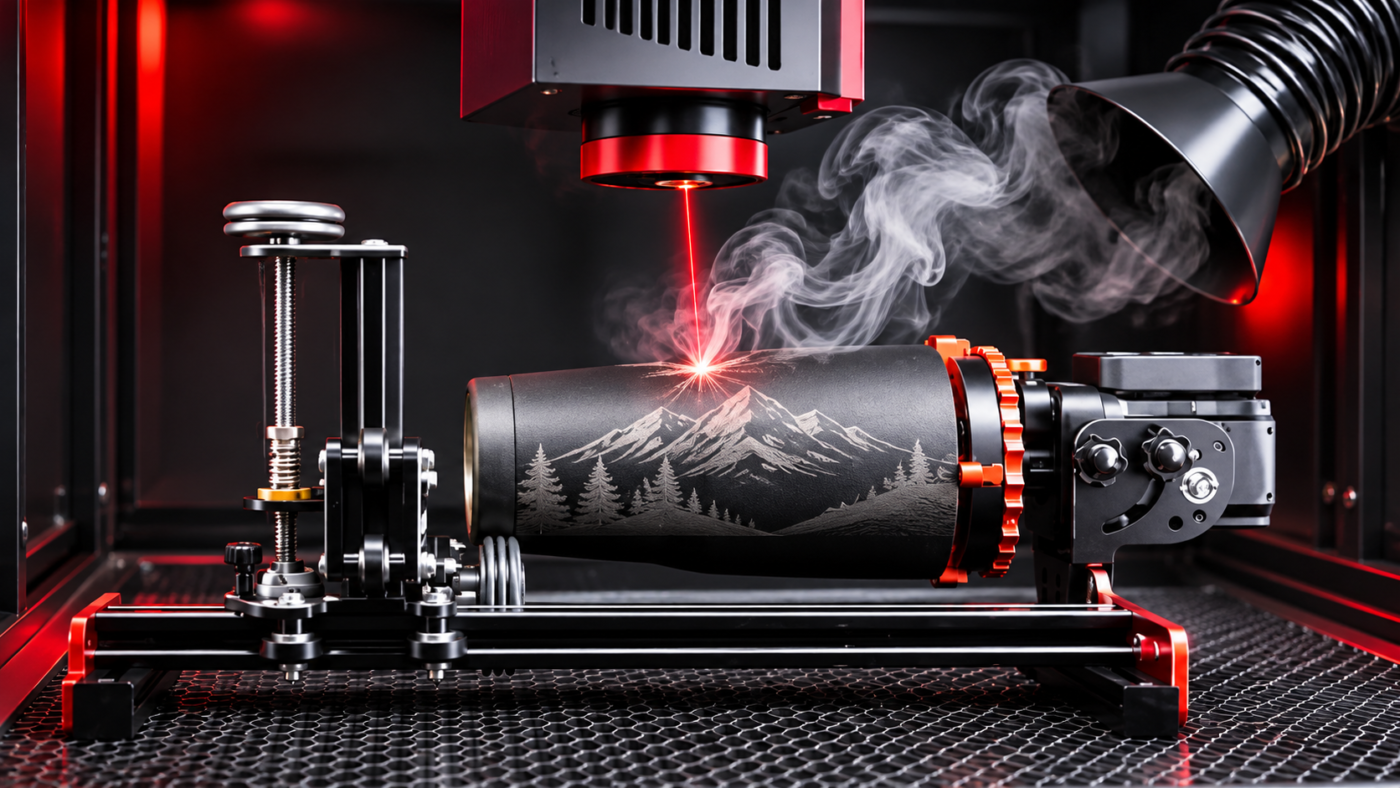
Consider an open-frame fiber laser engraving a powder-coated tumbler.
As the laser removes the coating, fumes can rise and spread into the surrounding room.
An extraction hose positioned nearby may capture some of those emissions, but effectiveness depends on airflow, positioning, and air movement around the machine.
This is where source capture becomes important.
Source capture means collecting airborne contaminants as close as practical to where they’re generated, before they disperse through the workspace.
It’s a principle widely used in industrial ventilation.
How an Enclosure Changes the Equation
An appropriately designed laser enclosure surrounds the working area, creating a more controlled space for extraction.
When connected to a properly sized exhaust system, replacement air enters through designated openings while contaminated air is drawn toward the extraction port.
The objective isn’t to seal the fumes inside.
It’s to control the direction they travel and remove them before they spread.
An enclosure doesn’t filter the air by itself. It supports the extraction system’s ability to capture it.
Purpose-Built Enclosures for Galvo Lasers
Many fiber and UV galvo lasers are sold with open working areas, leaving operators to develop their own fume management arrangements.
Purpose-built enclosures can help address that challenge while also providing suitable physical barriers around the laser working area.
For example, Tico Laser offers customizable galvo laser enclosures with extraction ports, multiple access configurations, and protective viewing windows specified for compatible laser wavelengths.
The enclosures are designed around the working area rather than necessarily surrounding the entire machine, allowing access to other components while supporting directed extraction.
They are intentionally not airtight, since a functioning exhaust system requires incoming replacement air.
Like any enclosure, their effectiveness depends on correct installation, suitable extraction equipment, and adequate airflow.
Additional information is available in the Tico Laser Enclosure Guide.
Outdoor Exhaust or Recirculating Filtration?
Once fumes are captured, they need to go somewhere.
Two common approaches are outdoor exhaust and filtered recirculation.
Outdoor Exhaust
A properly designed system removes contaminated air from the laser workstation and discharges it to a suitable outdoor location.
Where practical and permitted, this is often preferable to returning filtered air into the workspace.
However, exhaust must be discharged away from windows, air intakes, neighboring occupants, and other locations where contaminants could create exposure problems.
Adequate replacement air is also necessary.
Recirculating Filtration
When outdoor exhaust isn’t possible, a suitable professional fume extraction system may provide an alternative.
These systems often combine particulate filtration with activated carbon or specialized chemical filtration media.
However, their effectiveness depends on the contaminants being generated, filter specifications, maintenance, and whether the system is suitable for the intended application.
Not every laser process is appropriate for recirculating filtration.
An effective setup might combine a purpose-built enclosure with an appropriately selected multi-stage extraction and filtration system. The equipment must be matched to the process, and its performance should be verified rather than assumed.
Five Things Every Laser Owner Should Check
Before assuming your ventilation setup is effective, ask yourself:
- Where are the fumes going? Are they being captured at the source or spreading through the room?
- Does the system handle gases? HEPA filtration alone isn’t sufficient for chemical vapors.
- Is there enough airflow? Duct length, bends, filter resistance, and fan performance all matter.
- When were the filters last changed? Activated carbon has a limited capacity.
- Are the materials safe to process? PVC, vinyl, and certain plastics can generate dangerous emissions. Avoid processing materials without verifying their composition and suitability.
These questions are relevant whether you’re operating a small desktop laser or a professional engraving workshop.
The Bottom Line: Control the Source, Not Just the Smell
Laser engraving fumes deserve more attention than they often receive.
Visible smoke is only part of the picture. HEPA filters capture particles but not gases, and activated carbon has limitations that are easy to overlook.
Advanced multi-stage filtration systems can offer additional treatment options, but effective fume management still begins with capturing contaminants close to their source.
For many laser workspaces, a properly ventilated enclosure can be a useful part of that strategy.
Ultimately, the goal isn’t simply to make smoke and odors disappear.
It’s to reduce unnecessary exposure before it happens.
References and Further Reading
- U.S. Environmental Protection Agency — Guide to Air Cleaners in the Home
- California Air Resources Board — Indoor Air Cleaners for Removal of Odors and Gases
- University of Pennsylvania — Makerspace and Laboratory Design Guidelines
Educational disclaimer: This article provides general information about laser-generated air contaminants and ventilation principles. It is not a substitute for equipment-specific safety guidance, professional ventilation design, or applicable workplace safety requirements.
